

Why Your Brain Prefers Your Old Slice Over Your New Swing
By Kevin Cotter, PGA
1. The Hook: The Frustration of the Lesson Tee
It is a cycle that defines the amateur experience. You spend an hour on the range with an instructor who identifies a clear mechanical flaw. You see the error on video, you digest the logic of the correction, and for a brief window—perhaps the remainder of the session or a single Saturday morning—you experience what feels like a breakthrough. The contact is crisp, the ball flight is true, and you feel you have finally turned a corner.
Then, inevitably, the “Cognitive Stage spike” fades. By the third hole on Sunday, the old slice reasserts itself with a vengeance. You are left with the maddening question identified in The Subconscious Swing: “If I understand what I’m supposed to do, why can’t I just do it?”
If you find yourself trapped in this loop, the issue isn’t your athletic talent or your intelligence. The problem is a fundamental misunderstanding of the biological requirements of change. You aren’t failing at golf; you are failing to respect the architecture of your own nervous system.
2. Knowing is Not Doing: The Biological Gap
In modern golf, clarity is frequently mistaken for change. We assume that once a concept “makes sense,” the skill has been acquired. Neuroscience tells a different story: understanding and execution are handled by two separate, often competing, brain systems.
When you process a new swing thought, you are engaging the Prefrontal Cortex. This region is the seat of conscious logic and language. While it excels at analyzing video or reading a book, it is a catastrophic failure at managing a golf swing in real time. As the source text explains:
“It’s too slow and too energy-intensive for real-time coordination.”
Consistent, high-performance movement is instead the domain of the Motor Control Network, specifically the cerebellum and basal ganglia. These nodes specialize in automatic sequencing and timing, operating at speeds the conscious mind cannot touch. The “gap” exists because your knowledge is stored in the prefrontal cortex, but your movement pattern is still being dictated by an un-reprogrammed motor network. Until that pattern is encoded neurally, “knowing” is merely an intellectual exercise.
3. The Three Stages of Mastery (and Why You’re Stuck in Stage 1)
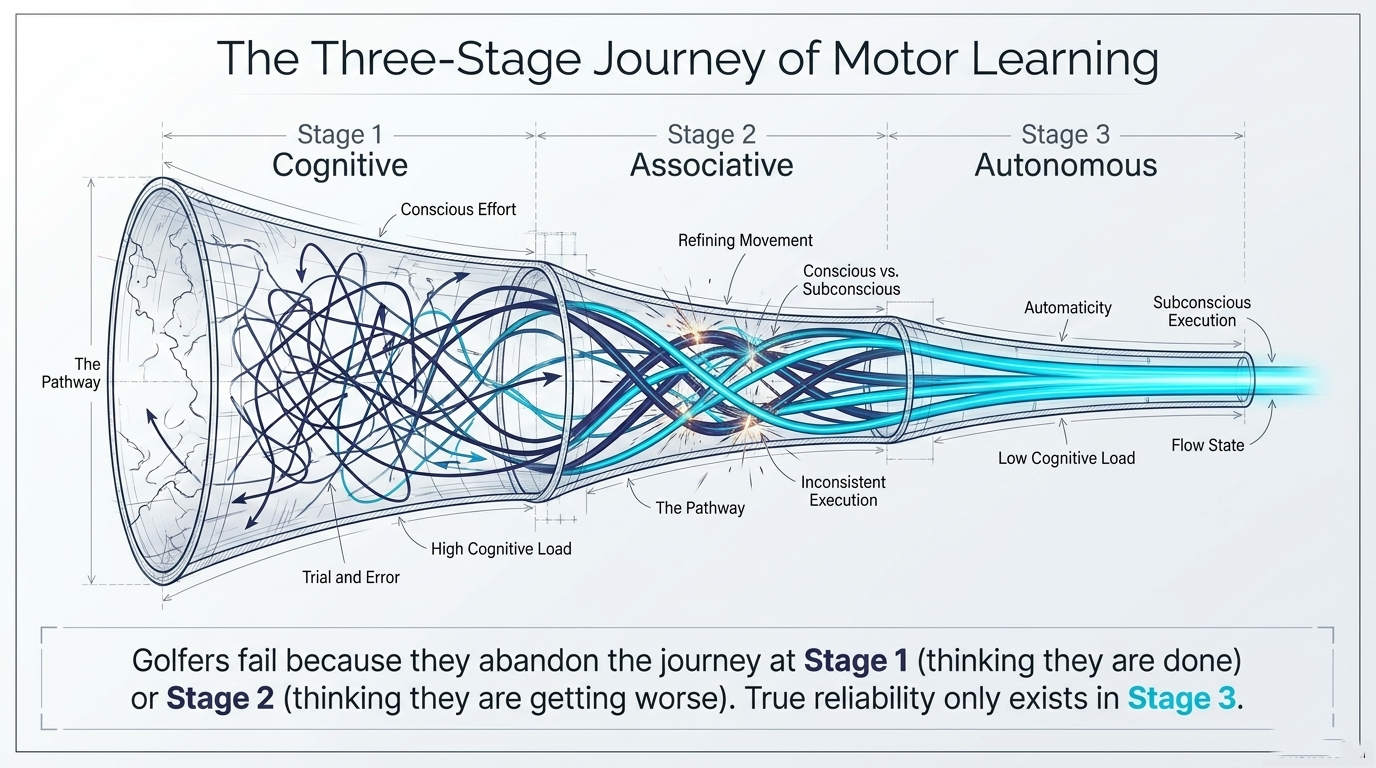
To move a skill from an idea into an instinct, every golfer must navigate three distinct biological stages. Most stall at the very beginning.
- The Cognitive Stage: This is the phase of awareness. You are thinking about positions, angles, and sequences. Movement is deliberate, effortful, and erratic. Most golf instruction exists solely here, providing a temporary sense of progress that lacks a biological foundation.
- The Associative Stage: This is the “Valley of Neural Competition.” The movement feels more natural, but it still requires conscious monitoring to prevent the old habit from taking over. Results are uneven. This is where the majority of golfers quit, misinterpreting natural variability as a sign that the change “isn’t working.”
- The Autonomous Stage: The objective. The motor control network has fully encoded the pattern. The swing no longer requires conscious monitoring and can withstand the pressure of a Sunday afternoon because it is no longer dependent on the prefrontal cortex.
Most golfers fail because they abandon the process in the Associative stage, never allowing the cerebellum and basal ganglia to take full ownership.
4. The Scaffolding Trap: Why You’re Better When the Pro is Watching
Many golfers lament, “I wish you could be here for every shot, because when you’re here, I can do it.” This is not a compliment to the teacher’s personality; it is a description of External Scaffolding.
During a lesson, the pro’s presence serves to offload your cognitive load. The instructor is essentially acting as your external prefrontal cortex, artificially narrowing your focus and filtering out distractions. This creates “provisional success.” You aren’t actually “better” in that moment; you are simply less autonomous. You haven’t “owned” the skill; you are merely performing within a temporary support structure. When the scaffolding is removed on the first tee, your divided attention causes the fragile, unencoded movement to collapse.
5. The 12-Week Rule: Why You Must Finish What You Start
The failure to automate a swing often stems from “scattered intentions.” Consider the case of a professional golfer who spent three years trying to fix his driver swing without success. Despite hitting thousands of balls, his focus shifted daily—takeaway one day, transition the next. Because his repetitions were never concentrated on a single node, his nervous system never received the consistent signal required for automation.
Contrast this with the mid-handicap golfer who tried to change six things in one season. By the end of the year, his ball-striking was unchanged. He famously remarked:
“I feel like I’m gathering swing thoughts rather than actually building a swing.”
The central truth of motor learning is that true automaticity requires protecting a single intention for an extended period—typically 12 weeks. To move a skill into the autonomous stage, you must commit to a single pattern for 3 consecutive months without switching, adding, or modifying it. Biological integrity requires finishing what you start.
6. When ‘Getting Worse’ is Actually a Sign of Progress
The most common point of failure for a golfer is the onset of “awkwardness.” When contact deteriorates, they assume the change is wrong. In reality, they are experiencing Neural Competition.
Your old swing is supported by heavily myelinated neural pathways. Myelin acts as a biological insulator; the more a path is used, the more it is insulated, making the signal faster and more efficient. Your old slice is literally “better wired” than your new swing.
When you introduce a new move, the brain enters a phase in which it activates a “confused mix” of the old, myelinated path and the new, weak path. This discomfort is the feeling of your brain deciding which path to trust. If you quit because it feels “wrong,” you stop at the exact moment your nervous system is beginning to reorganize. You are abandoning the investment just as the myelin is beginning to wrap around the new habit.
7. Conclusion: From Awareness to Automaticity
Lasting golf improvement is not about a “missing key” or a secret tip. It is a strategic investment in habituation. To break the cycle, you must shift your perspective from seeking quick fixes to building biological structures.
Mastery demands disciplined patience. You must stop judging your practice by the quality of the shots and start judging it by the integrity of your intention. Real progress is invisible; it happens in the deepening of neural pathways and the thickening of myelin.
The process of moving from awareness to automaticity works, provided you don’t interrupt it. The question is: will you trust the biology long enough to finish the job?
Read the book, The Subconscious Swing, now available for Kindle eBook pre-order, publication date 05/28/2026, paperback releases same day.