You just had a great lesson. Your pro explained exactly what you were doing wrong, showed you the fix, and it made perfect sense. You even hit a few good ones before you left.
Then you stepped onto the first tee Saturday morning — and the old swing came back like it never left.
Sound familiar?
It’s not a lack of effort. It’s not poor instruction. It’s neuroscience.
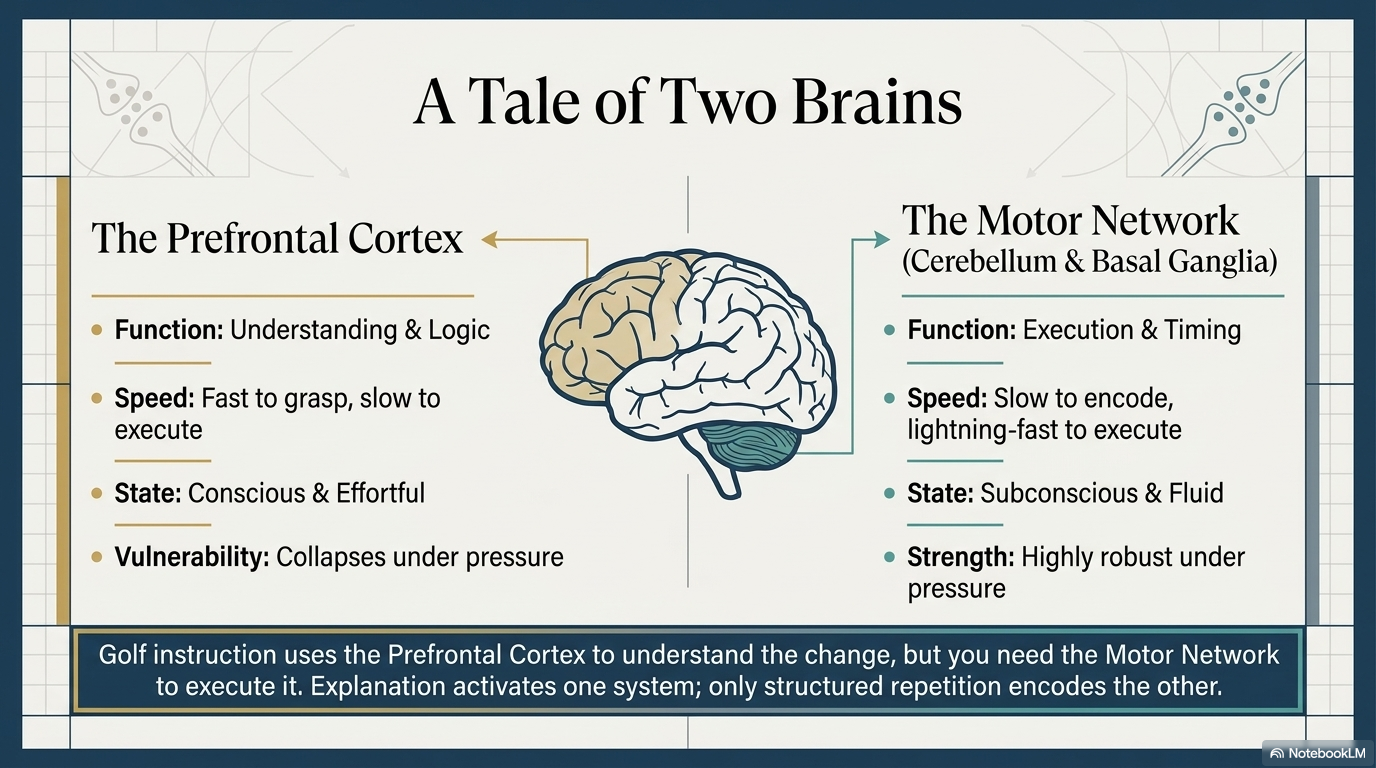
Your brain has two very different systems at work every time you swing a golf club.
The first is the Prefrontal Cortex — the thinking brain. It understands logic, processes instructions, and grasps new concepts quickly. When your pro explains the fix, this is the system that nods and says, “Got it.” It’s fast to understand but slow to execute, and under pressure it has a critical vulnerability — it collapses.
The second is the Motor Network — the Cerebellum and Basal Ganglia. This is your execution system. It controls timing, smooth movement, and automatic performance. It’s slow to encode new patterns, but once it does, it executes with lightning speed. Better yet — it’s highly robust under pressure. This is the system that swings the club when it matters.
Here’s the problem most golfers never hear about.
Golf instruction almost exclusively engages the first system.
Your pro explains the change. Your Prefrontal Cortex fully understands it. You may even feel it briefly on the range. But understanding a movement and encoding it into your Motor Network are two entirely different neurological events. Explanation activates one system. Only structured repetition encodes the other.
This is why the swing you understood on Tuesday disappears by Saturday. The thinking brain got the message, but the executing brain never did.
This is the void The Subconscious Swing was written to fill.
Not another book about what to change — but a science-backed, in-depth exploration of howgolf skills become automatic. How the Motor Network learns. What structured repetition really means. And why the learning process itself, when understood correctly, changes everything about how you practice and play.
Because the goal was never just to understand a better swing.
The goal was always to own one.
The Subconscious Swing by Kevin Cotter, PGA — available now on Amazon.
This was a major championship defined by unpredictability.
At Aronimink Golf Club, 30 players entered Sunday within five shots of the lead, creating a logjam with little separation.
The 108th PGA Championship — featuring a mix of stars and first-time major contenders — ultimately came down to who could limit mistakes under pressure.
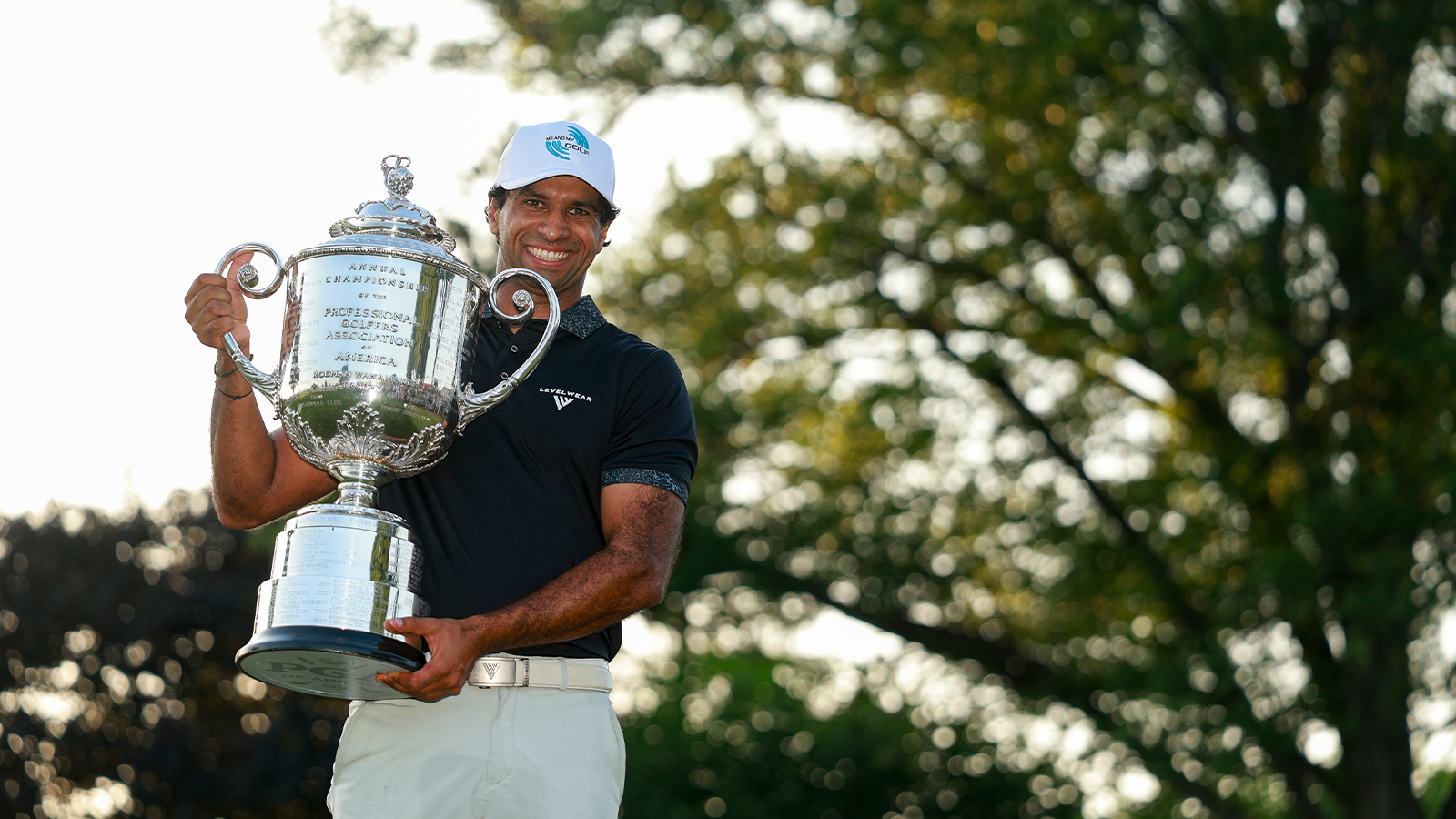
Aaron Rai (-9) did that, emerging as a first-time major winner by doing what Aronimink demanded most: staying disciplined, keeping the ball in play, and avoiding costly errors. He overcame three bogeys on the front nine, carded an eagle at No. 9, and closed with a bogey-free back nine that included four birdies.
A meticulous approach has long defined Rai’s game, even reflected in his signature two gloves.
Here are three lessons from the winner’s performance at Aronimink.
1. Distance Control on the Greens
The large greens and subtle slopes at Aronimink were a major talking point all week at the PGA Championship, making distance control — especially on longer putts — vital.
Rai produced one of the defining moments of his final round on the par-3 17th. Protecting a two-shot lead, he rolled in a 68-foot birdie putt that effectively secured his position heading to the final hole.
Rai had taken a conservative line off the tee, aiming for the right side of the green with a tucked pin on the left. The intent was a safe two-putt opportunity, but instead found the back of the cup.
Rai’s putting was steady all week, averaging 28.75 putts per round and ranking fifth in the field in strokes gained: putting (1.738).
For everyday golfers, putting is less about making birdies and more about putting yourself in position for an easy two-putt when needed.
1. Finding the right pace Distance control matters more than perfect reads. The goal is to leave every first putt within a comfortable range. Before a round, spend time hitting long putts to calibrate speed. Every course plays differently.
2. Convert the short ones Distance control is important, but so is capitalizing on makeable putts. Work on putts inside 15 feet with a variety of breaks to build confidence from different looks.
2. Pick Smart Targets Off the Tee
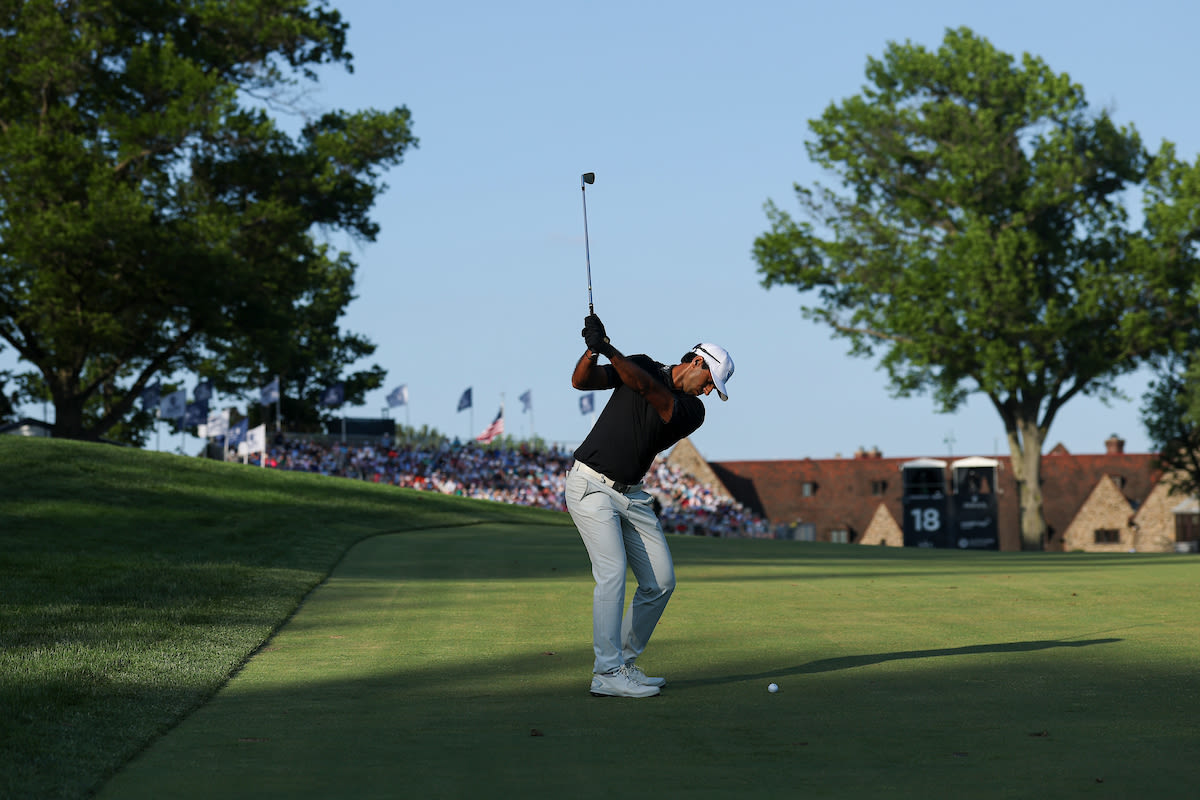
Rai’s back nine on Sunday offered a glimpse at the kind of ball-striker he is. He consistently put himself into scoring opportunities.
He was one of the most accurate drivers on tour last season, a strength displayed this week at the PGA Championship, where he ranked fourth in driving accuracy (67.86%).
Rai separated himself on Sunday by staying disciplined and committed with his targets, and Aronimink rewarded him.
While most everyday golfers won’t match that level of driving precision, the process can be the same.
1. Take trouble out of play Good target selection isn’t just about picking a line — it’s about removing danger. If there’s trouble on one side, factor it into your pre-shot decision.
2. Play to the widest part of the landing area On tight or penal holes, choose the part of the fairway that gives you the most margin for error.
3. Trust your go-to ball flight Forcing a shot shape that isn’t natural often leads to tentative swings. Under pressure, commit to your most reliable ball flight to hit the fairway.
3. Avoid the Big Number
The defining theme all week at Aronimink has been that big numbers are more damaging than missed birdie opportunities.
Donald Ross’ design is not overly tight from tee to green, but missed fairways and greens have quickly turned into costly numbers when players have been unable to recover.
For everyday golfers, protecting against big numbers is essential. A par is a good score, and sometimes bogey is an acceptable outcome when trouble arises. Conservative targets and smart misses can be the difference in posting a decent round.
Rai made just one double bogey on his way to becoming a major champion, a reflection of how effectively he limited damage throughout the week.
Here are three ways everyday golfers can avoid big numbers:
1. Aim for the center of the green When trouble is in play, prioritize the largest section of the green to eliminate short-siding and reduce the risk of big numbers.
2. Accept bogey early Too often, amateurs try to salvage par from difficult positions, leading to further damage. Playing for bogey when needed is often the smartest decision.
3. Club down when control is off If the driver isn’t cooperating, don’t force it. Use a fairway wood or hybrid to keep the ball in play. The swing can be fixed later on the range, not mid-round.
Why Your Brain Prefers Your Old Slice Over Your New Swing
By Kevin Cotter, PGA
1. The Hook: The Frustration of the Lesson Tee
It is a cycle that defines the amateur experience. You spend an hour on the range with an instructor who identifies a clear mechanical flaw. You see the error on video, you digest the logic of the correction, and for a brief window—perhaps the remainder of the session or a single Saturday morning—you experience what feels like a breakthrough. The contact is crisp, the ball flight is true, and you feel you have finally turned a corner.
Then, inevitably, the “Cognitive Stage spike” fades. By the third hole on Sunday, the old slice reasserts itself with a vengeance. You are left with the maddening question identified in The Subconscious Swing: “If I understand what I’m supposed to do, why can’t I just do it?”
If you find yourself trapped in this loop, the issue isn’t your athletic talent or your intelligence. The problem is a fundamental misunderstanding of the biological requirements of change. You aren’t failing at golf; you are failing to respect the architecture of your own nervous system.
2. Knowing is Not Doing: The Biological Gap
In modern golf, clarity is frequently mistaken for change. We assume that once a concept “makes sense,” the skill has been acquired. Neuroscience tells a different story: understanding and execution are handled by two separate, often competing, brain systems.
When you process a new swing thought, you are engaging the Prefrontal Cortex. This region is the seat of conscious logic and language. While it excels at analyzing video or reading a book, it is a catastrophic failure at managing a golf swing in real time. As the source text explains:
“It’s too slow and too energy-intensive for real-time coordination.”
Consistent, high-performance movement is instead the domain of the Motor Control Network, specifically the cerebellum and basal ganglia. These nodes specialize in automatic sequencing and timing, operating at speeds the conscious mind cannot touch. The “gap” exists because your knowledge is stored in the prefrontal cortex, but your movement pattern is still being dictated by an un-reprogrammed motor network. Until that pattern is encoded neurally, “knowing” is merely an intellectual exercise.
3. The Three Stages of Mastery (and Why You’re Stuck in Stage 1)
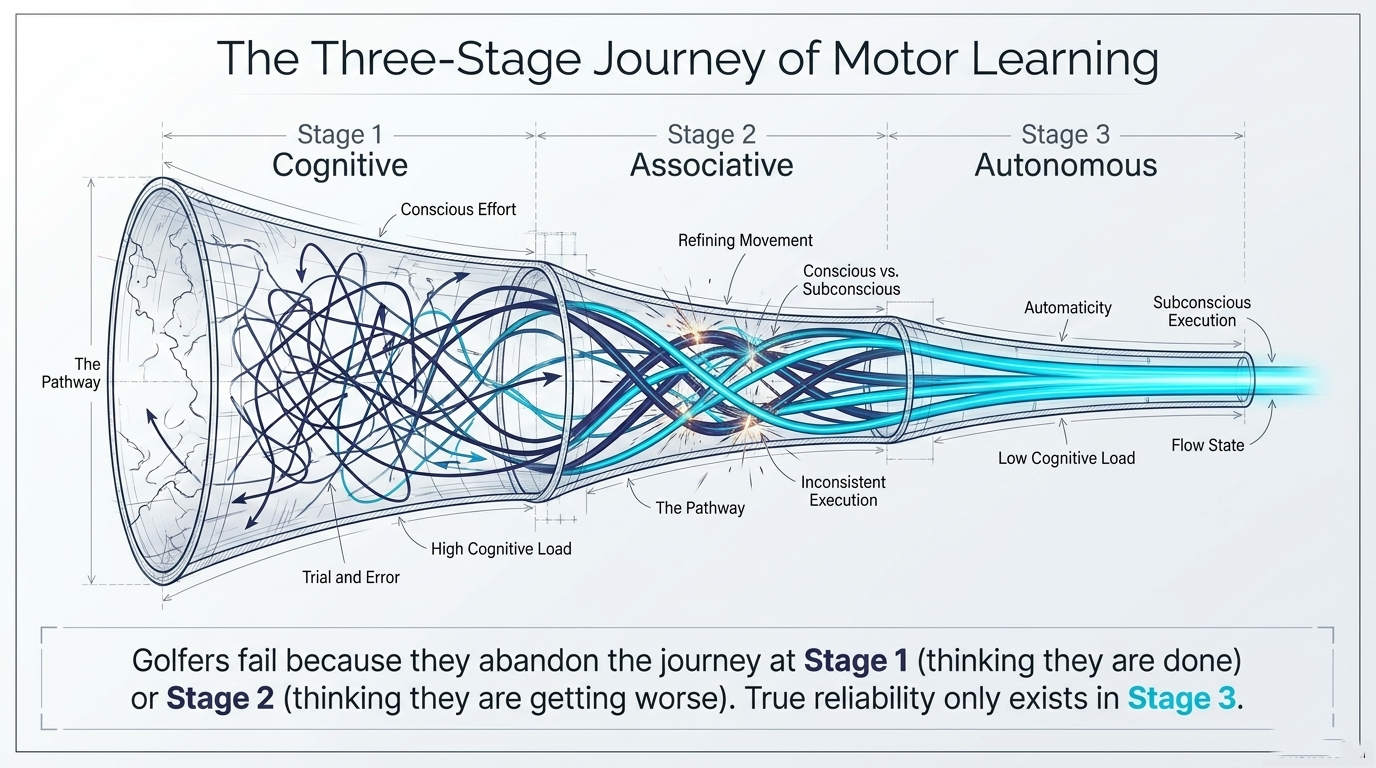
To move a skill from an idea into an instinct, every golfer must navigate three distinct biological stages. Most stall at the very beginning.
The Cognitive Stage: This is the phase of awareness. You are thinking about positions, angles, and sequences. Movement is deliberate, effortful, and erratic. Most golf instruction exists solely here, providing a temporary sense of progress that lacks a biological foundation.
The Associative Stage: This is the “Valley of Neural Competition.” The movement feels more natural, but it still requires conscious monitoring to prevent the old habit from taking over. Results are uneven. This is where the majority of golfers quit, misinterpreting natural variability as a sign that the change “isn’t working.”
The Autonomous Stage: The objective. The motor control network has fully encoded the pattern. The swing no longer requires conscious monitoring and can withstand the pressure of a Sunday afternoon because it is no longer dependent on the prefrontal cortex.
Most golfers fail because they abandon the process in the Associative stage, never allowing the cerebellum and basal ganglia to take full ownership.
4. The Scaffolding Trap: Why You’re Better When the Pro is Watching
Many golfers lament, “I wish you could be here for every shot, because when you’re here, I can do it.” This is not a compliment to the teacher’s personality; it is a description of External Scaffolding.
During a lesson, the pro’s presence serves to offload your cognitive load. The instructor is essentially acting as your external prefrontal cortex, artificially narrowing your focus and filtering out distractions. This creates “provisional success.” You aren’t actually “better” in that moment; you are simply less autonomous. You haven’t “owned” the skill; you are merely performing within a temporary support structure. When the scaffolding is removed on the first tee, your divided attention causes the fragile, unencoded movement to collapse.
5. The 12-Week Rule: Why You Must Finish What You Start
The failure to automate a swing often stems from “scattered intentions.” Consider the case of a professional golfer who spent three years trying to fix his driver swing without success. Despite hitting thousands of balls, his focus shifted daily—takeaway one day, transition the next. Because his repetitions were never concentrated on a single node, his nervous system never received the consistent signal required for automation.
Contrast this with the mid-handicap golfer who tried to change six things in one season. By the end of the year, his ball-striking was unchanged. He famously remarked:
“I feel like I’m gathering swing thoughts rather than actually building a swing.”
The central truth of motor learning is that true automaticity requires protecting a single intention for an extended period—typically 12 weeks. To move a skill into the autonomous stage, you must commit to a single pattern for 3 consecutive months without switching, adding, or modifying it. Biological integrity requires finishing what you start.
6. When ‘Getting Worse’ is Actually a Sign of Progress
The most common point of failure for a golfer is the onset of “awkwardness.” When contact deteriorates, they assume the change is wrong. In reality, they are experiencing Neural Competition.
Your old swing is supported by heavily myelinated neural pathways. Myelin acts as a biological insulator; the more a path is used, the more it is insulated, making the signal faster and more efficient. Your old slice is literally “better wired” than your new swing.
When you introduce a new move, the brain enters a phase in which it activates a “confused mix” of the old, myelinated path and the new, weak path. This discomfort is the feeling of your brain deciding which path to trust. If you quit because it feels “wrong,” you stop at the exact moment your nervous system is beginning to reorganize. You are abandoning the investment just as the myelin is beginning to wrap around the new habit.
7. Conclusion: From Awareness to Automaticity
Lasting golf improvement is not about a “missing key” or a secret tip. It is a strategic investment in habituation. To break the cycle, you must shift your perspective from seeking quick fixes to building biological structures.
Mastery demands disciplined patience. You must stop judging your practice by the quality of the shots and start judging it by the integrity of your intention. Real progress is invisible; it happens in the deepening of neural pathways and the thickening of myelin.
The process of moving from awareness to automaticity works, provided you don’t interrupt it. The question is: will you trust the biology long enough to finish the job?
Read the book, The Subconscious Swing, now available for Kindle eBook pre-order, publication date 05/28/2026, paperback releases same day.
Every golfer believes their inconsistency comes from swing mechanics, tempo, or setup. But the truth is far simpler—and far more powerful.
Most golfers fall into the same predictable pattern:
They react to outcomes instead of committing to intentions.
And this one mental mistake quietly destroys rounds, confidence, and rhythm more than anything else.
Let’s break it down.
The Hidden Trap — Playing Reactive Golf
A reactive golfer plays golf after the swing is over.
They judge the shot. They tighten on the next one. They shift their focus. They lose rhythm. They chase a “quick fix” mid-round.
The pattern looks like this:
Hit a poor shot → emotional spike
Try harder on the next one → tension rises
Overcorrect → mechanics collapse
Confidence wavers → performance spirals
Instead of controlling their state, they let the result control them.
This is reactive golf—and almost every golfer does it.
The Elite Difference — Playing With Intention
Great players aren’t perfect. They miss fairways and greens like everyone else.
But they don’t let the miss define the next swing.
They commit to an intention before the swing and judge success based on:
Did I commit?
Did I choose the correct shot?
Did I stay neutral after the outcome?
Outcome is information. Intention is control.
This is the foundation of playing intentional golf.
Why Intention Matters More Than Mechanics
Your mechanics don’t break down randomly. They break down when your mind and body become misaligned.
Intention creates:
clarity
consistency
confidence
rhythm
freedom
When intention is strong, your movement becomes organized.
When intention collapses, tension takes over.
If you want reliable mechanics, you must first control your mental process—because it controls everything else.
The 3-Step Reset to Stop Reactive Golf
Here is a simple, tour-tested process you can use immediately:
1. Pause the Reaction
Right after the shot, do nothing. No judgment. No emotion. Just a breath.
This creates space—it’s the difference between reacting and responding.
2. Ask the Only Question That Matters
“Did I commit to the shot?”
If yes → accept and move on. If no → reset your process—not your swing.
This question puts you back in control.
3. Anchor the Next Intention
Before the next shot, define:
target
shape or trajectory
feel or cue
acceptance
When intention is clear, the body organizes itself around it.
This is the secret to consistent golf.
How This One Shift Lowers Scores
When you stop reacting and start committing, three things happen almost immediately:
1. Your tension levels drop
You no longer “try harder” or “force” swings.
2. Your misses improve
A committed miss is almost always playable.
3. Your rhythm stabilizes
You stop jumping between swing thoughts, fixes, and emotional reactions.
Most golfers think they need a better swing. What they really need is better intention.
Final Thought — The Shot Matters Less Than the State You’re In
Consistency comes from your mental state, not your mechanics.
If you can adopt one change today, let it be this:
Judge each shot by your commitment, not your outcome.
It will radically change the way you play golf.
Ready to Transform Your Mental Game?
This concept—and dozens of others like it—is explored in depth in my book, The Modern Psychology of Golf.
If these concepts resonated, and you’re ready to build further clarity, confidence, and consistency on the course, you’ll love the deeper mental strategies inside the book 👉 Amazon.
From The Modern Psychology of Golf — by Kevin Cotter, PGA
Every golfer has a swing pattern — but fewer realize they also have an emotional pattern.
Your emotional pattern is your internal fingerprint — the recurring thoughts, reactions, and habits that show up when pressure builds.
“You cannot manage what you do not first recognize.”
Once pressure hits, patterns reveal themselves.
Some golfers fall apart after a bad opening hole. Others tighten up when they realize they’re on track for a great round. Some go into “attack mode,” trying to force shots. Others shift into fear-based golf, just trying not to lose.
A quiet moment of clarity — the golfer pauses, visualizes, and commits before the first tee shot.
The key is this:
You cannot manage what you do not first recognize.
Before you can control your emotions, you have to observe them.
Awareness Comes Before Change
Improving the mental game begins with noticing, not fixing.
We don’t judge. We don’t label. We simply observe.
Instead of thinking, “I shouldn’t feel this way,” we move to “Interesting — this is how I respond in this situation.”
That’s emotional clarity.
How to Identify Your Emotional Patterns (4 Questions to Ask Yourself)
Next time you play, carry these with you (or jot them into a journal afterward):
What situations tend to rattle me the most on the course? Opening tee shots… recovery shots… protecting a good score?
When do I usually lose focus most often? After a mistake… or after something good happens?
What does the voice in my head say when I’m under pressure? Is it supportive… or critical?
How does my body respond when I feel frustrated or anxious? Tension? Quick tempo? Shoulders tighten? Breath shortens?
The more specific your answers, the faster your growth.
Why This Matters
Once you identify your emotional patterns, you can:
Interrupt negative spirals sooner
Build routines that stabilize your mindset
Stay composed during high-pressure moments
Play the round you’re capable of — not one hijacked by emotion
Emotional mastery doesn’t mean you stop feeling pressure. It means the pressure no longer controls you.
If you want to build consistency, confidence, and emotional control — not just once, but every round — you’ll love:
📘 The Modern Psychology of Golf Your blueprint for mastering golf’s invisible game.