

Why Golf Lessons Don’t Always Stick: A Tale of Two Brains

By Kevin Cotter, PGA

You just had a great lesson. Your pro explained exactly what you were doing wrong, showed you the fix, and it made perfect sense. You even hit a few good ones before you left.

Then you stepped onto the first tee Saturday morning — and the old swing came back like it never left.

Sound familiar?

It’s not a lack of effort. It’s not poor instruction. It’s neuroscience.


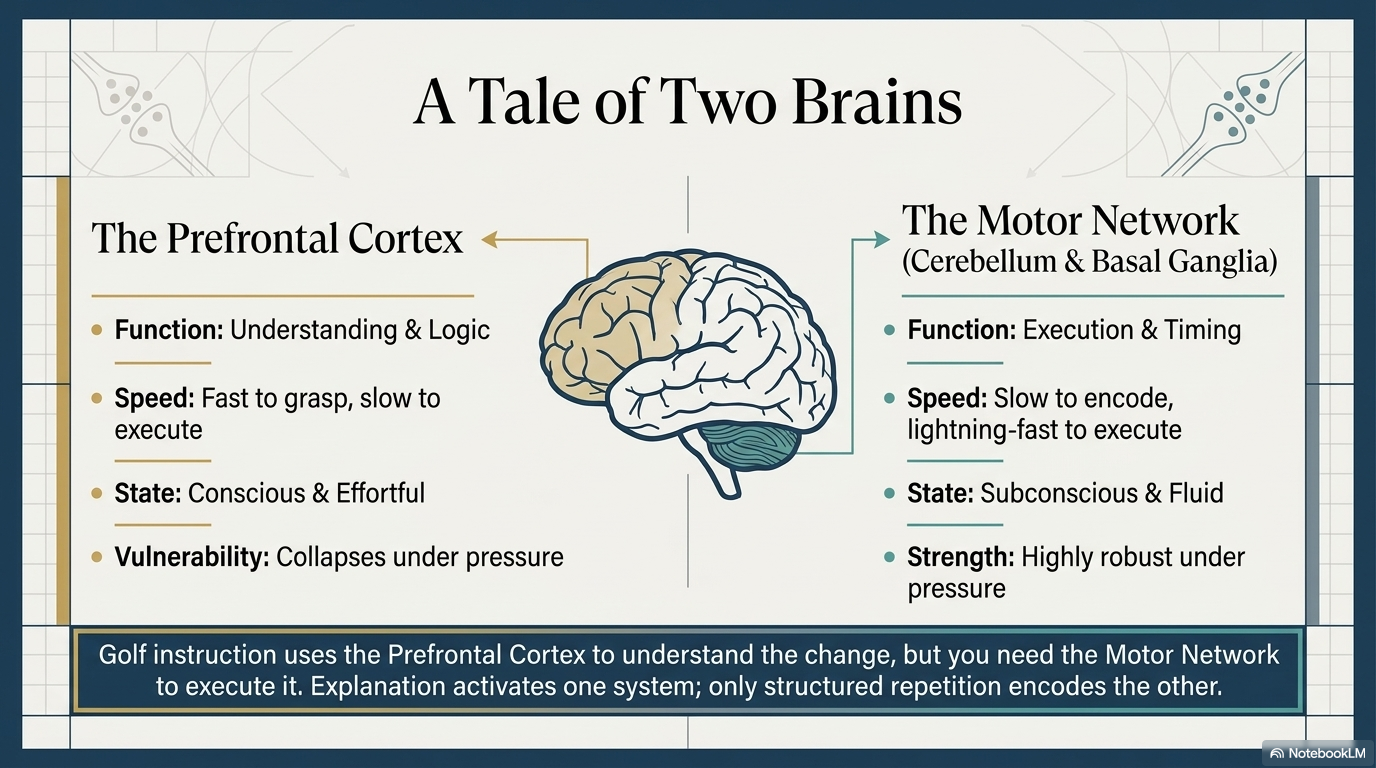
Your brain has two very different systems at work every time you swing a golf club.

The first is the Prefrontal Cortex — the thinking brain. It understands logic, processes instructions, and grasps new concepts quickly. When your pro explains the fix, this is the system that nods and says, “Got it.” It’s fast to understand but slow to execute, and under pressure it has a critical vulnerability — it collapses.

The second is the Motor Network — the Cerebellum and Basal Ganglia. This is your execution system. It controls timing, smooth movement, and automatic performance. It’s slow to encode new patterns, but once it does, it executes with lightning speed. Better yet — it’s highly robust under pressure. This is the system that swings the club when it matters.

Here’s the problem most golfers never hear about.

Golf instruction almost exclusively engages the first system.

Your pro explains the change. Your Prefrontal Cortex fully understands it. You may even feel it briefly on the range. But understanding a movement and encoding it into your Motor Network are two entirely different neurological events. Explanation activates one system. Only structured repetition encodes the other.

This is why the swing you understood on Tuesday disappears by Saturday. The thinking brain got the message, but the executing brain never did.

This is the void The Subconscious Swing was written to fill.

Not another book about what to change — but a science-backed, in-depth exploration of how golf skills become automatic. How the Motor Network learns. What structured repetition really means. And why the learning process itself, when understood correctly, changes everything about how you practice and play.

Because the goal was never just to understand a better swing.

The goal was always to own one.


The Subconscious Swing by Kevin Cotter, PGA — available now on Amazon.

Learn it. Trust it. Play it.


The Mental Mistake 90% of Golfers Don’t Realize They’re Making

By Kevin Cotter, PGA

Every golfer believes their inconsistency comes from swing mechanics, tempo, or setup.
But the truth is far simpler—and far more powerful.

Most golfers fall into the same predictable pattern:

They react to outcomes instead of committing to intentions.

And this one mental mistake quietly destroys rounds, confidence, and rhythm more than anything else.

Let’s break it down.


The Hidden Trap — Playing Reactive Golf

A reactive golfer plays golf after the swing is over.

They judge the shot.
They tighten on the next one.
They shift their focus.
They lose rhythm.
They chase a “quick fix” mid-round.

The pattern looks like this:

  • Hit a poor shot → emotional spike
  • Try harder on the next one → tension rises
  • Overcorrect → mechanics collapse
  • Confidence wavers → performance spirals

Instead of controlling their state, they let the result control them.

This is reactive golf—and almost every golfer does it.


The Elite Difference — Playing With Intention

Great players aren’t perfect. They miss fairways and greens like everyone else.

But they don’t let the miss define the next swing.

They commit to an intention before the swing and judge success based on:

  • Did I commit?
  • Did I choose the correct shot?
  • Did I stay neutral after the outcome?

Outcome is information.
Intention is control.

This is the foundation of playing intentional golf.


Why Intention Matters More Than Mechanics

Your mechanics don’t break down randomly.
They break down when your mind and body become misaligned.

Intention creates:

  • clarity
  • consistency
  • confidence
  • rhythm
  • freedom

When intention is strong, your movement becomes organized.

When intention collapses, tension takes over.

If you want reliable mechanics, you must first control your mental process—because it controls everything else.


The 3-Step Reset to Stop Reactive Golf

Here is a simple, tour-tested process you can use immediately:


1. Pause the Reaction

Right after the shot, do nothing.
No judgment.
No emotion.
Just a breath.

This creates space—it’s the difference between reacting and responding.


2. Ask the Only Question That Matters

“Did I commit to the shot?”

If yes → accept and move on.
If no → reset your process—not your swing.

This question puts you back in control.


3. Anchor the Next Intention

Before the next shot, define:

  • target
  • shape or trajectory
  • feel or cue
  • acceptance

When intention is clear, the body organizes itself around it.

This is the secret to consistent golf.


How This One Shift Lowers Scores

When you stop reacting and start committing, three things happen almost immediately:

1. Your tension levels drop

You no longer “try harder” or “force” swings.

2. Your misses improve

A committed miss is almost always playable.

3. Your rhythm stabilizes

You stop jumping between swing thoughts, fixes, and emotional reactions.

Most golfers think they need a better swing.
What they really need is better intention.


Final Thought — The Shot Matters Less Than the State You’re In

Consistency comes from your mental state, not your mechanics.

If you can adopt one change today, let it be this:

Judge each shot by your commitment, not your outcome.

It will radically change the way you play golf.


Ready to Transform Your Mental Game?

This concept—and dozens of others like it—is explored in depth in my book,
The Modern Psychology of Golf.

If these concepts resonated, and you’re ready to build further clarity, confidence, and consistency on the course, you’ll love the deeper mental strategies inside the book 👉 Amazon.