

Why Golf Lessons Don’t Always Stick: A Tale of Two Brains

By Kevin Cotter, PGA

You just had a great lesson. Your pro explained exactly what you were doing wrong, showed you the fix, and it made perfect sense. You even hit a few good ones before you left.

Then you stepped onto the first tee Saturday morning — and the old swing came back like it never left.

Sound familiar?

It’s not a lack of effort. It’s not poor instruction. It’s neuroscience.


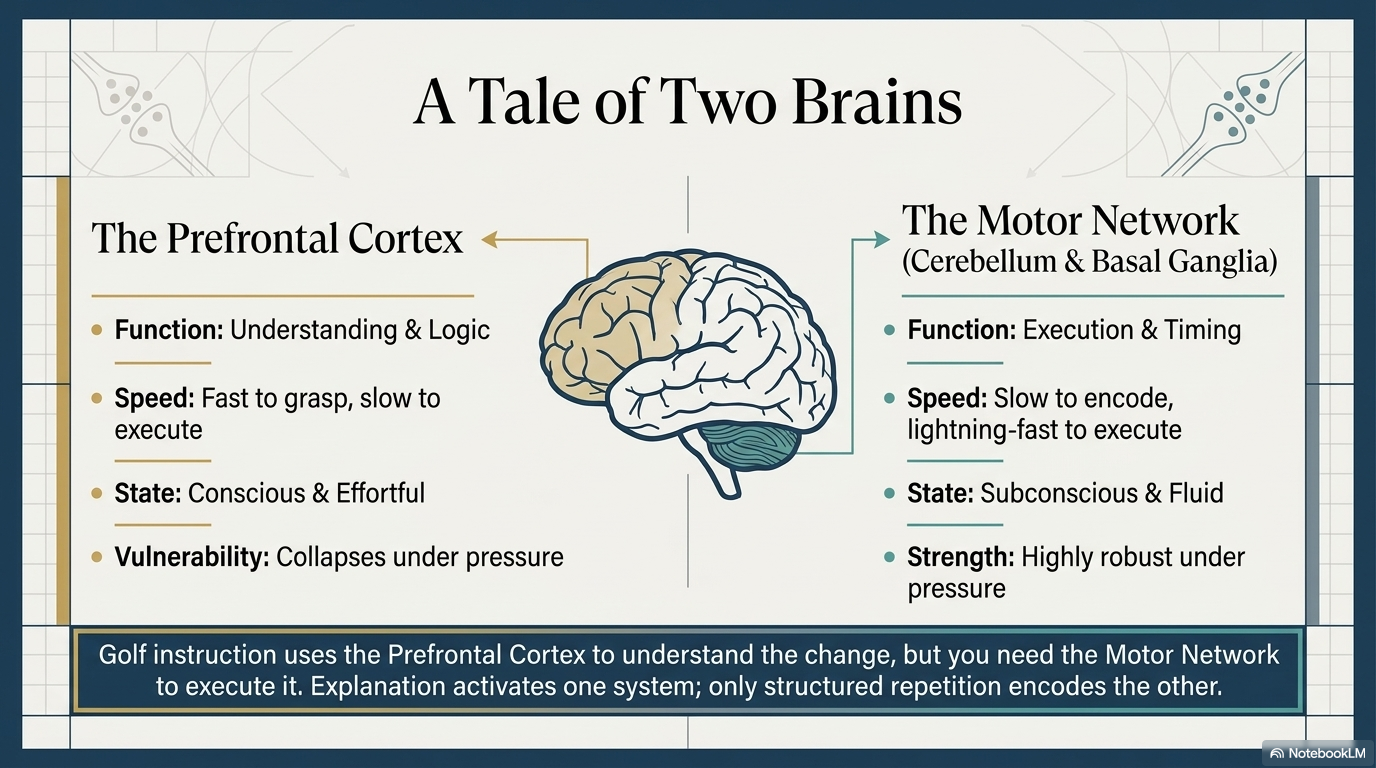
Your brain has two very different systems at work every time you swing a golf club.

The first is the Prefrontal Cortex — the thinking brain. It understands logic, processes instructions, and grasps new concepts quickly. When your pro explains the fix, this is the system that nods and says, “Got it.” It’s fast to understand but slow to execute, and under pressure it has a critical vulnerability — it collapses.

The second is the Motor Network — the Cerebellum and Basal Ganglia. This is your execution system. It controls timing, smooth movement, and automatic performance. It’s slow to encode new patterns, but once it does, it executes with lightning speed. Better yet — it’s highly robust under pressure. This is the system that swings the club when it matters.

Here’s the problem most golfers never hear about.

Golf instruction almost exclusively engages the first system.

Your pro explains the change. Your Prefrontal Cortex fully understands it. You may even feel it briefly on the range. But understanding a movement and encoding it into your Motor Network are two entirely different neurological events. Explanation activates one system. Only structured repetition encodes the other.

This is why the swing you understood on Tuesday disappears by Saturday. The thinking brain got the message, but the executing brain never did.

This is the void The Subconscious Swing was written to fill.

Not another book about what to change — but a science-backed, in-depth exploration of how golf skills become automatic. How the Motor Network learns. What structured repetition really means. And why the learning process itself, when understood correctly, changes everything about how you practice and play.

Because the goal was never just to understand a better swing.

The goal was always to own one.


The Subconscious Swing by Kevin Cotter, PGA — available now on Amazon.

Learn it. Trust it. Play it.


Five Tips Pros Use to Make More Putts

By Kevin Cotter, PGA

Nothing separates weekend warriors from elite golfers like putting. The pros sink putts with confidence, while amateurs often struggle with consistency. If you want to roll the ball like the best, you need more than just luck—you need a solid routine, proper technique, and a confident mindset. Here are five pro-level tips to help you make more putts and lower your scores.

2017 NCLM Conference Golf TournamentPhoto by Aaron Hines

1. Master Your Setup and Alignment

Pros take their setup seriously. Even a perfect stroke won’t get the ball in the hole if you’re not correctly aligned. The key? Keep your feet, knees, hips, and shoulders parallel to your target line. Many pros use alignment aids in practice to reinforce proper positioning. Also, ensure your eyes are directly over the ball or slightly inside the target line for optimal accuracy.

2. Develop a Smooth, Repeatable Stroke

One of amateur golfers’ most common mistakes is getting too handsy with the putter. Pros focus on a consistent stroke powered by the shoulders, keeping the hands quiet. A smooth pendulum-like motion leads to better distance control and accuracy. To improve, try the “gate drill” by placing two tees slightly wider than your putter head. If you don’t hit the tees, your stroke will stay on path.

3. Read Greens Like a Pro

Good putting starts before you even stroke the ball. Pros read greens from multiple angles, considering grain, slope, and speed. A great technique is the “low side read,” where you examine the putt from the side that slopes downward. Use your feet to feel subtle breaks, and practice lag putts to develop a better sense of green speed. The more you understand the break, the more putts you’ll make.

4. Control Your Speed

Even the best read means nothing if your speed control is off. Pros focus on rolling the ball with perfect pace, often aiming to have it finish about 12-18 inches past the hole if they miss. A great drill to improve speed is the “ladder drill,” where you putt balls to stop at different distances within a designated zone. Mastering speed prevents those dreaded three-putts and boosts confidence on short putts.

5. Commit to Every Putt with Confidence

Doubt is the silent killer of a good putt. The best players trust their read, commit fully to their stroke, and let go of the outcome. Before you putt it, take a deep breath, visualize the ball rolling smoothly into the cup, and step up with confidence. A hesitant stroke leads to missed opportunities, but a committed one—even if you miss—sets you up for long-term success on the greens.

Now, grab your putter and have some fun out there! 🏌️‍♂️