

By Kevin Cotter, PGA
You just had a great lesson. Your pro explained exactly what you were doing wrong, showed you the fix, and it made perfect sense. You even hit a few good ones before you left.
Then you stepped onto the first tee Saturday morning — and the old swing came back like it never left.
Sound familiar?
It’s not a lack of effort. It’s not poor instruction. It’s neuroscience.
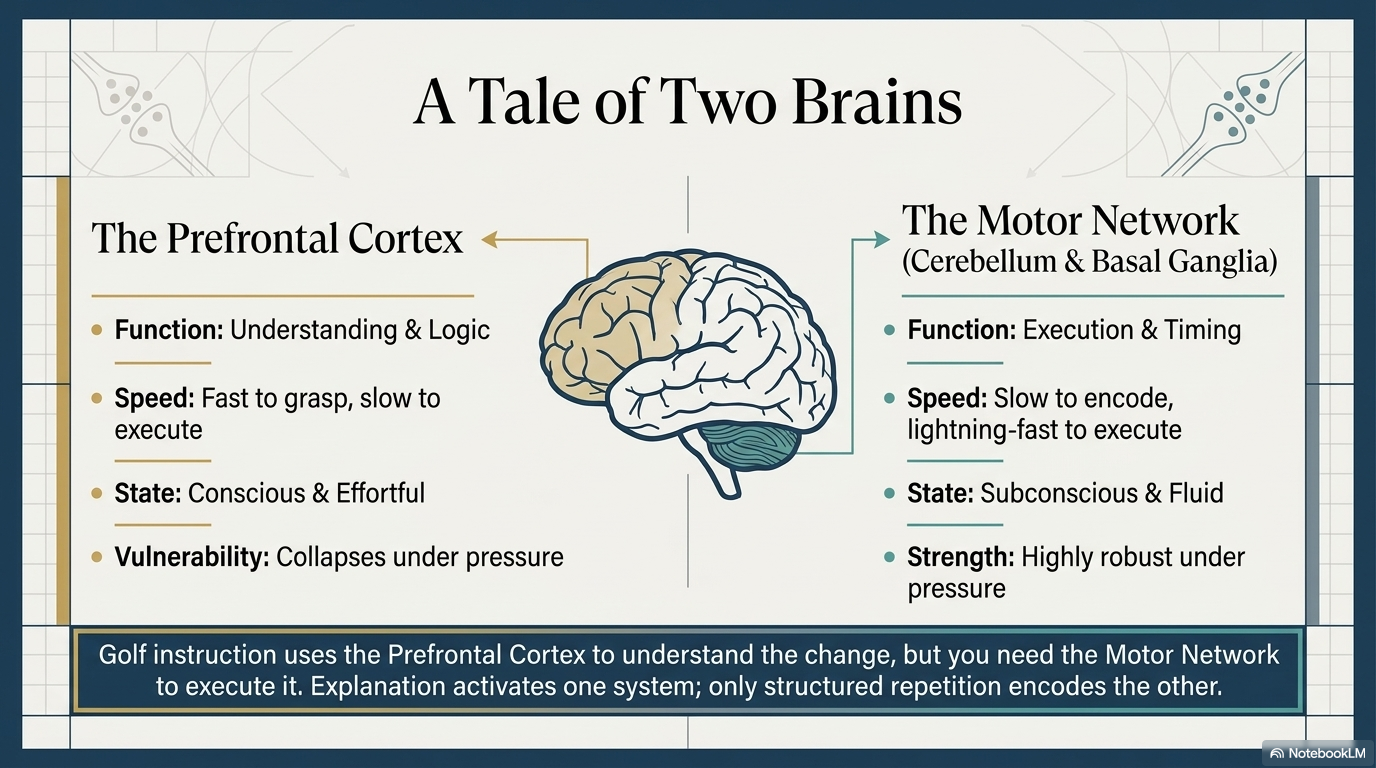
Your brain has two very different systems at work every time you swing a golf club.
The first is the Prefrontal Cortex — the thinking brain. It understands logic, processes instructions, and grasps new concepts quickly. When your pro explains the fix, this is the system that nods and says, “Got it.” It’s fast to understand but slow to execute, and under pressure it has a critical vulnerability — it collapses.
The second is the Motor Network — the Cerebellum and Basal Ganglia. This is your execution system. It controls timing, smooth movement, and automatic performance. It’s slow to encode new patterns, but once it does, it executes with lightning speed. Better yet — it’s highly robust under pressure. This is the system that swings the club when it matters.
Here’s the problem most golfers never hear about.
Golf instruction almost exclusively engages the first system.
Your pro explains the change. Your Prefrontal Cortex fully understands it. You may even feel it briefly on the range. But understanding a movement and encoding it into your Motor Network are two entirely different neurological events. Explanation activates one system. Only structured repetition encodes the other.
This is why the swing you understood on Tuesday disappears by Saturday. The thinking brain got the message, but the executing brain never did.
This is the void The Subconscious Swing was written to fill.
Not another book about what to change — but a science-backed, in-depth exploration of how golf skills become automatic. How the Motor Network learns. What structured repetition really means. And why the learning process itself, when understood correctly, changes everything about how you practice and play.
Because the goal was never just to understand a better swing.
The goal was always to own one.
The Subconscious Swing by Kevin Cotter, PGA — available now on Amazon.
Learn it. Trust it. Play it.