
Get More Distance Out Of The Ground

NEW RESEARCH

Get More Distance Out Of The Ground

3 power moves the pros make that you don’t

WITH RON KASPRISKE
PHOTO BY STEPHEN SZURLEJ

March 2011

There are a lot of differences between the golf swing of an elite player and that of the average amateur, but what are the biggest? Let’s look at what most golfers want more than anything: power. My work with biomechanics researcher Jean-Jacques Rivet has proved that most amateurs don’t push into the ground effectively to create leverage in their swings. And leverage leads to power.

With the use of J.J.’s data, we’ve found three spots in the average golfer’s swing where a lack of leverage is most evident: the takeaway, halfway back and the transition. I’m going to share our findings with you and give you some drills to fix these power leaks. Follow our advice, and you’ll start hitting the ball better than ever.

1.THE START OF THE BACKSWING

Ground force in the takeaway: 
Pro: 125% of body weight
Amateur: 70% of body weight
Most amateurs tend to lose leverage early in the backswing by raising their bodies, which lightens the force they apply to the ground. The pros do the opposite and apply even more force, giving them a much more stable base to coil the upper body.

leadbetter

DRILL
Take a wood block or similarly weighted object such as a hardcover book and place it behind your 6-iron at address. Push the block away from the target as you start your backswing (right. You should feel pressure building in your right heel as well as the ball of your left foot from the extra effort it takes to move the block.

2. HALFWAY BACK

Ground force in the takeaway: 
Pro: 125% of body weight
Amateur: 65% of body weight

Even if they had good ground force at the start of the swing, many amateurs lose that grounded feeling at this point. As that pressure decreases, they stop coiling and begin to lift their hands and arms as a compensatory move to finish the backswing. Pros continue to coil all the way to the top because they’re still grounded.

leadbetter

DRILL
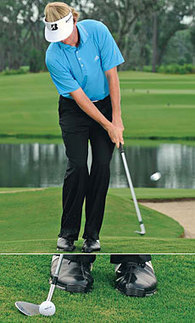
Place a club on the ground and stand on the shaft with both feet as shown (right, shoes optional). Then swing a 6-iron while standing on the shaft. As you move past the halfway point in your backswing, you should feel a steady or increasing amount of force in your right heel and the middle of your left foot. Because of this force, you should be able to complete your upper-body turn just like the pros do.

3. THE TRANSITION

Ground force in the takeaway: 
Pro: 145% of body weight
Amateur: 90% of body weight

As the club starts down, elite players increase the pressure under their feet — it looks as if they’re starting to squat — which shallows the swing plane and increases clubhead lag. It’s a huge power move. Most amateurs swing down on too steep of a plane and release the clubhead lag early, usually resulting in a weak slice. They often have more ground-force pressure halfway down than at impact. The sequence of the downswing should be from the ground up, but these players frequently do just the opposite, leading with the upper body.

leadbetter

DRILL

Set up with your feet and hips open to the target and take the club to the top. As you start to swing down (right), rotate your hips in a clockwise direction — a feeling of closing them off to your target even more. This dynamic move will force you to push into the ground with your front leg. It also will keep your shoulders from unwinding early and will drop your arms and club onto a shallow plane. Those are keys to hitting a powerful shot that curves from right to left.

BIOS
DAVID LEADBETTERa Golf Digest Teaching Professional, is based at ChampionsGate, near Orlando. JEAN-JACQUES RIVET is the sports biomechanics consultant to the European Tour.

Fairway Bunker Shots

Tips and instruction to learn proper fairway bunker shot technique.

By Kevin Cotter, PGA

The primary difference between a fairway bunker shot and a green side bunker shot is you strike the ball first then the sand in a fairway bunker.  The angle of attack to the ball is also more shallow than that of a green side bunker, in a fairway bunker the clubhead travels somewhat level to the ground through impact.

Also, position the ball more towards the middle of your stance.

Plan on up to a 1/3 distance loss with fairway bunker shots, therefore you may have to take some extra club, but do make sure you still have enough loft to to clear the lip of the bunker.

Check out the video link below with PGA Professional Michael Breed demonstrating a key tip on how to position the right foot in the sand in an effort to stabilize the back leg during the swing minimizing lower body movement. You must emphasize movement of the upper body with fairway bunker shots and keep the lower body fairly quiet.  This helps prevent your feet from pivoting/shifting in the sand during the swing.

Fairway Bunker Shots | PGA.com

PGA Professional Michael Breed hits Hazeltine National Golf Club to give you some helpful tips on the best ways to get out of those dre…
Below, Phil Micklelson describes the shallow attack angle and how he casts the club (breaks the wrists early in the downswing) to create a more shallow angle:


Happy golfing!

Spirit of Golf

spirit of golf thought of the day

April 28, 2013

Most do not understand that true power comes from releasing internal resistance rather than from pursuing, chasing, toil, and grind. We become conditioned to believe that we have to effort hard in order to achieve everything we want; in effect, we must struggle to deserve our success. In truth, we could relax and chill our way into receiving anything we want and desire, unless we don’t believe this to be true. Our belief about how easily results will unfold is ultimately what makes them appear. It is we and we alone who get to decide how much joy or misery is going to be involved along the way.

Orlando, FL – April, 2013 

 Irish Links Trip

Upcoming events

Join us in the following cities for upcoming Spirit of Golf workshops and clinics. For a full listing of our upcoming events, including our webinars and player/instructor certification programs, click here.

Practicing Your Golf Swing in Slow Motion

  1. Slow down when working on your swing for amazing results!

    Practicing your golf swing in slow motion is a concept I’ve always believed in and have religiously articulated throughout my teaching career, “If you can’t do it in slow motion, how could you ever do it in fast motion.”

    Now some have argued they are not one in the same in the sense that with a full speed swing the dynamics are different when considering the impetus generated through centripetal force.  I believe this is true but only to a certain degree as they are overall missing the point that the player first needs to understand the exact positions they need to achieve within the swing and repeat those motions slowly over and over again and habituate them then slowly transgress over to full speed swing.

    Check out the Slow Mo Drill video below:

  2. Amazing, here is a video of Ben Hogan actually practicing in slow motion as referenced above by Brad Brewer.
  3. [youtube http://www.youtube.com/watch?v=h5vTfi0gtZ8?feature=oembed&w=400&h=225]
  4. Just for the sake of analysis here is a great slow motion swing video with Professional Golf Coach Mitchell Spearman examining the swing of the 2010 US Open Champion Graeme McDowell.

Executing the Perfect Pitch Shot

  1. This is a great tip to improve your pitching game.  The primary key to the shot is keeping the arms, shoulders and body moving somewhat in sync as described in this article by Krista Dunton PGA, by allowing the right elbow to fold against the right side during the back swing and left elbow to fold against the left side during the through swing.  Check out the article and video below for some great short game pointers.
  2. Todd Anderson on the Pitch Shot
  3. [youtube http://www.youtube.com/watch?v=WGA9HofE1Ek?feature=oembed&w=400&h=225]

The Golf Grip: Your Essential Foundation for a Consistent Swing

By Kevin Cotter, PGA
The grip is the crucial link between your body and the golf club — the point where feel, control, and power all begin. Arnold Palmer captured it perfectly:

“The grip is the crucial junction point from which all the body’s strength and rhythm are transferred to the club.”

A sound grip is not just a fundamental—it’s the foundation of every consistent, repeatable golf swing.


The Three Primary Golf Grips

Golfers generally use one of three classic grip styles. Each has unique benefits, and understanding them helps you select the grip that best suits your hands, mechanics, and comfort.


1. The Overlapping Grip (Vardon Grip)

The most widely used grip in golf, named after legendary champion Harry Vardon.

How it works:

  • The right pinky rests on top of the gap between the left index and middle fingers.
  • This softly “connects” the hands into one unified unit.

Benefits:

  • Encourages a natural release of the club.
  • Promotes hand unity without tension.
  • Ideal for players with medium or larger hands.

This grip is the preferred choice for most advanced golfers because it blends control with fluidity.


2. The Interlocking Grip

A favorite among players wanting an even more secure hand connection. Used famously by Jack Nicklaus and Tiger Woods.

How it works:

  • The right pinky hooks around the left index finger, interlocking them together.

Benefits:

  • Creates a very strong, unified hand structure.
  • Prevents the dominant hand from overpowering the swing.
  • Great for players with smaller hands or those seeking tighter control.

If your hands tend to separate during the swing, this grip can be a game-changer.


3. The Ten-Finger Grip (Baseball Grip)

Less common among seasoned golfers, but incredibly useful for beginners and players with limited strength.

How it works:

  • All ten fingers remain in contact with the club, similar to holding a baseball bat.

Benefits:

  • Easy to learn and very comfortable.
  • Provides leverage for players who need extra strength.
  • Ideal for juniors, newcomers, or players overcoming physical limitations.

While it may lack some refined control, it is an excellent stepping-stone grip for developing players.


Choosing the Right Grip for Your Game

There is no single “correct” grip — just the one that fits your hands, preferences, and golf goals.

Ask yourself:

  • Which grip feels most natural?
  • Do my hands stay connected throughout the swing?
  • Am I gaining control without adding tension?

Mastering your grip is one of the fastest ways to improve ball striking, create consistency, and unlock your natural swing motion.

Releasing the Clubhead

This story is for you if…
• You want more distance and accuracy
• You often miss your target to the right
• You don’t understand what “release” means
Photo By J. D. Cuban/Golf Digest

BY ERIKA LARKIN

It’s no big mystery why you’re slicing your driver. The clubface is open to your swing path at impact. And that slice can get worse if you pull in your arms on the downswing to try to steer the ball into the fairway. Here’s my easy fix: Remember to roll and reach as you swing through. Let your forearms roll over to square the clubface and then reach your arms toward the target.

You can get a feel for this full release by hitting some “bunt” shots with your driver. Tee up a ball and take your driver back until the shaft is parallel to the ground and the toe of the club points straight up (see photo). From there, focus on extending the shaft toward the target so it mirrors that halfway-back position, with the toe up again. Bunt some balls down the range, and don’t worry about distance.

 The Standard Advice

Try to square the clubface at impact for straighter and more accurate shots.

Why it’s Misleading

Impact lasts only a few milliseconds, so trying to perfect that moment is nearly impossible.

The Tip You Really Need

A solid release guarantees proper clubface rotation through impact, so perfect it instead. Plus, it’s easier to control your release. As you drive through the hitting zone, give the ball a slap with your right hand, changing your right wrist from bent back to bowed. Check the positions at left to see what it looks like.

 Elbow In

Your left elbow should hang tight against your torso as your hands release. You can’t unhinge your wrists if your left arm bows out (no chicken-winging).

 Shoulder Under

Your right shoulder moves under your chin, not in front of it. This allows your hands to power the clubhead correctly through impact and then around your body.

 KEY MOVE – Active Wrists

Prior to impact your right wrist was bent. Now it should be bowed. This doesn’t happen by itself—”slap” the ball with your right hand to release the club properly.

 Club on Line

A proper release whips the clubhead around your body in a circular motion and into your finish.


My Favorite Shots To Save Par

See on Scoop.itgolf instruction

Brandt Snedeker shares his favorite shots around the green. (RT @GolfDigestMag: One of Brandt Snedeker’s favorite shots around the green? The hands-free lob.

BestGolfeBooks‘s insight:

The "Hands free lob" is an adaptation to the pitching swing and is a great tool in and around the green.  The firmness in the hands provides a high degree of consistency.

See on www.golfdigest.com

How to Start the Golf Swing

By Kevin Cotter, PGA

The takeaway or start of the golf swing begins with combined movement of the clubhead, hands, arms and shoulders.

This movement, commonly referred to as the “one-piece takeaway” is quickly followed by the hips as they begin to turn in response to the shoulders.  As the hips rotate the lower body (knees and feet) become active as the weight begins to transfer back onto and eventually around the right leg.

Soon after the “once piece takeaway” begins, allow your right elbow to fold somewhat against your right side, at least in the early stages of the backswing.  This allows the arms to remain connected to the body.

The “one piece takeaway” sets the timing of the swing into immediate sync.  The desired sequence of movement is; clubhead, hands, shoulders, hips and lower body in that order.   This backswing sequencing establishes proper coiling of the upper body against the lower body, providing a power generating spring like action to be unleashed during the downswing. Correct timing also helps establish a square clubface position at the top of the swing.

In addition to timing, the proper takeaway is crucial in developing power through angular momentum or also known as the “lever system.”  Proper use of the “lever system” not only unleashes tremedous power but helps establish a ball first then turf strike when playing shots directly off the turf.  Learning to strike the ball with a descending blow is vital, a downward strike to a ball sitting on the turf provides the much needed spin necessary for the ball to stick and hold in the intended target area.

Also, the path of the club is hugely influenced by the natural flow of the “one-piece takeaway.” When not contrived in any way the club moves straight back then slightly to the inside around then up. Eventually, the club returns somewhat along the same path on the way down, creating a semi-circle pattern starting from behind the ball through the ball and into the through swing.

If the club is forced quickly to the outside during the initial stages of the backswing an out to in swing path is likely to be created. Conversely, if you force the club back too quickly to the inside,  the club eventually has nowhere to go but to be forced to the outside and then back across the ball resulting in pulled or sliced shots.

So, as you can now clearly see, the “one piece takeaway” is the crucial first step in developing a powerful repeating golf swing, and provides the ability to consistently strike the ball cleanly and squarely,  leading to longer and straighter shots.

For the best golf training and instructional aids on the web please go tohttp://www.BestGolfeBooks.com your golf eBook superstore andhttp://www.EasytoLearnGolf.com blog for more great stuff to improve your game. Lower scores are just a click away!

Happy golfing!

Article Source: http://EzineArticles.com/?expert=Kevin_R._Cotter

Spirit of Golf

spirit of golf thought of the day

March 24, 2013

There is often a mindset of, “I’ll work hard now so that I can reap the rewards and relax and enjoy later on.”  From the standpoint of Law of Attraction, it doesn’t quite work that way.  For starters, nothing can come into our “now” experience that doesn’t require lots of hard work (and usually the accompanying toil, burnout, and grind).  Then, just about the time we get ready to reap the rewards, life continues to be challenging and hard, not because it really is, but because we never learned we could have anything we wanted the easy and effortless way.

St. Lucie West, FL – March, 2013 

Irish Links

Upcoming events

Join us in the following cities for upcoming Spirit of Golf workshops and clinics. For a full listing of our upcoming events, including our webinars and player/instructor certification programs, click here.  To discuss private coaching opportunities with Tim, click here.